A pretty logo is merely a graphic decoration, whereas a working brand is an instant trigger of trust and recognition, the reason a customer remembers your business the moment they see an everyday object like a coffee cup or a receipt. If your visual identity looks sleek and professional, yet your sales are stalling, you don’t have a graphic design problem; you have a positioning, messaging, and operational alignment problem.
Many business owners waste money on endless logo redesigns hoping it will fix their revenue. Here is the diagnostic breakdown Modern Chameleon uses to uncover why an attractive brand still fails to convert, and how to engineer a brand identity that actually drives sales.
1. The 4 Warning Signs of a “Broken” Brand
When your visual design looks polished on the surface, a failing brand reveals itself through specific operational friction:
- Constant Price Haggling: If you offer a high-ticket product or premium service, yet prospects constantly ask for discounts, your brand perception isn’t matching your price tag. Expensive offers require a high-trust, authoritative brand experience to justify the cost.
- High Traffic, Zero Conversions: Visitors land on your website or social media pages, look around, and leave without inquiring. Your visuals caught their eye, but your messaging failed to convince them you are trustworthy.
- Inconsistent Cross-Channel Identity: Your Instagram looks modern and trendy, your website reads like a dry corporate manual, and your Messenger replies sound robotic. Customers cannot recognize a unified identity.
- Internal Confusion: If your own staff cannot clearly explain in one sentence what makes your business unique compared to competitors, your customers certainly won’t figure it out.
2. The Messaging Disconnect: Sleek Visuals vs. “Affordable” Clichés
One of the fastest ways to destroy buyer trust is pairing a high-end, luxury visual identity with generic, copycat messaging like “We offer quality service at affordable prices.”
When your logo looks like an exclusive boutique, but your copy sounds like a clearance sale, it creates cognitive dissonance. The buyer subconsciously feels something is off. If you are truly a budget-friendly option, why are you dressing up like a luxury brand? Your visual assets, your core offer, and your copywriting must push the exact same agenda.
3. Brand Positioning in the Philippine Market: The Dialect & Industry Grid
In the Philippines, aligning your brand voice with a local dialect (such as Cebuano or Taglish) requires strategic precision based on your industry. Using local dialect naturally makes a brand feel closer to the community, which can sometimes be perceived as “budget” or “mass-market” if applied to luxury retail.
However, for community-driven services, speaking the local language is your strongest trust-building asset.
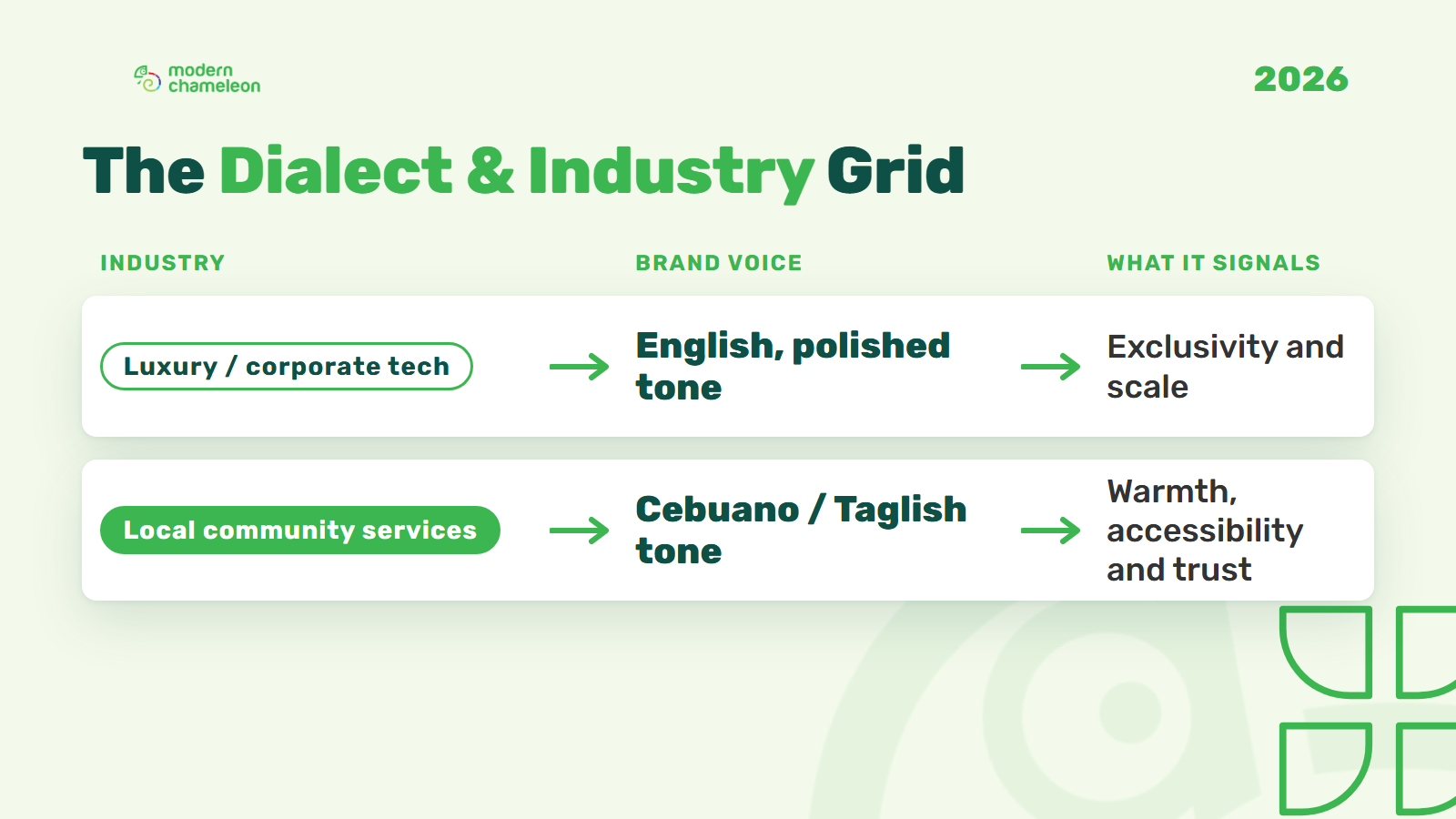
If you operate a service business catering directly to everyday local families, speaking their exact dialect removes corporate intimidation and proves you genuinely understand their daily struggles.
4. The Visual vs. Experience Gap
A brand is not just what you show; it is how your business actually operates. Many companies fail because they invest heavily in beautiful social media graphics while neglecting the actual customer journey.
Consider website performance: if a user clicks your sleek ad, only to stare at a blank screen for 10 to 20 seconds waiting for your website to load, your brand equity instantly evaporates. The customer subconsciously thinks: “If this company can’t even fix a slow website, how can I trust them with my money?” Slow website load times, clunky forms, and delayed Messenger replies will ruin a great logo every single time.
5. Case Study: Repositioning Mariland Lending
Real-World Application: Niche Positioning & Functional Trust
When we partnered with Mariland Lending, we didn’t just hand them a new graphic file; we overhauled their entire market positioning and customer experience.
- The Strategy: Instead of marketing to a broad, generic audience, we narrowed their brand positioning exclusively to serving Cebuano teachers and local market vendors.
- Visual & Messaging Alignment: We crafted a trustworthy, grounded visual identity utilizing reliable blues and steady mountain iconography, paired with warm, supportive messaging positioned as “a helping hand for teachers and vendors.”
- The Experience Fix: We backed up that brand promise with a custom website featuring an intuitive, multi-step online application form tailored specifically to how their target audience navigates digital tools. By aligning the visual identity, the local messaging, and a frictionless digital experience, Mariland Lending became a lending brand its teachers and vendors could recognize and trust.
6. Escaping the “Price-Competitor” Trap
Strategic branding is what allows you to stop competing in a race to the bottom on price and start commanding premium rates.
Consider launching a new cafe: during your soft opening, you might introduce lower promotional prices to attract initial foot traffic. However, your branding should never look cheap. By investing in a trustworthy, cohesive brand experience from Day 1, customers associate your name with quality and consistency rather than just being “the cheapest option.” Once that reputation is locked in, you can confidently transition to standard or premium pricing without losing your loyal customer base.
7. The Modern Chameleon Approach: Beyond the Logo
When a business owner comes to Modern Chameleon asking for a simple logo redesign, we shift the conversation immediately: you aren’t just redesigning a symbol; you are architecting your entire business identity.
Through our structured Discovery Stage, we audit your actual business bottlenecks before opening any design software:
- Problem Diagnosis: Identifying why your current funnel is leaking leads or attracting price-shoppers.
- Offer Architecture: Structuring your services so they clearly solve an urgent pain point.
- Target Audience Alignment: Pinpointing the exact demographic you want to win, and tailoring your voice, visuals, and digital touchpoints to convert them.
Stop Redesigning Your Logo. Start Fixing Your Brand Positioning.
If your business looks great on paper but struggles to close high-value clients without discounting your prices, it is time to audit your brand architecture. Talk to us about your brand and let’s align your visuals, messaging, and customer experience into an engine that converts.